
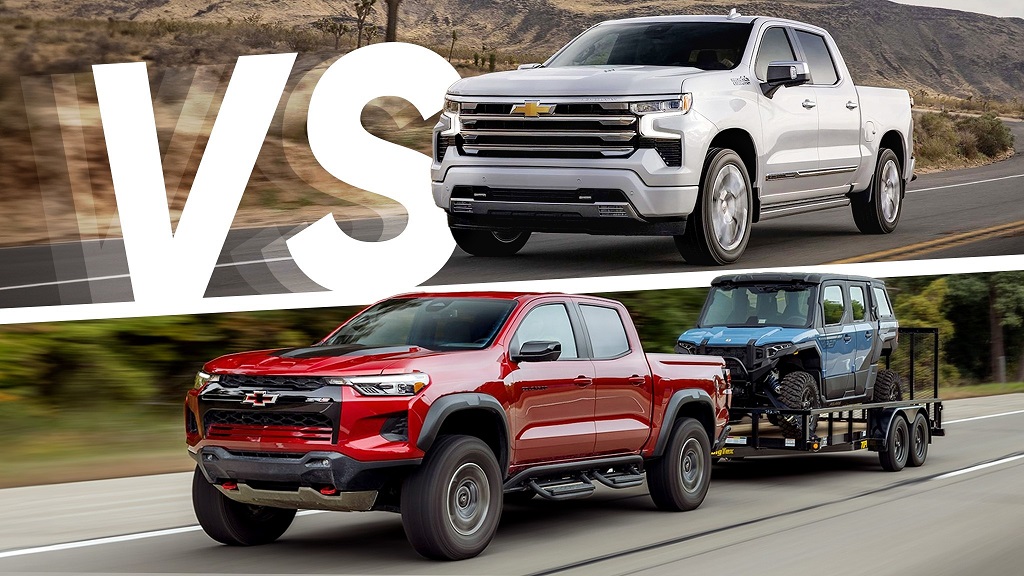
Chevrolet offers a wide range of pickup trucks, and two of its most talked-about models are the Colorado and the Silverado. While they share a brand heritage, they target different buyers. In this article, I’ll walk you through the key differences — from size and performance to value and capability — to help you choose the right one for your needs.
Overview: Midsize vs Full-Size
Chevy Colorado
The Colorado is Chevrolet’s midsize pickup. It’s built to balance capability with daily usability and is often chosen by buyers who want more utility than an everyday SUV but less bulk than a full-size truck.
The 2026 Colorado lineup offers up to **7,700 lbs towing** when properly equipped. :
Chevy Silverado
The Silverado sits in the full-size truck class. It’s Chevrolet’s workhorse — more powerful, heavier, and more versatile in configurations (bed lengths, cab styles, engine options). It’s often used for towing, hauling, and serious workloads.
Size & Dimensions
Size is one of the most obvious differences.
| Model | Typical Length* | Width | Height / Clearance |
|---|---|---|---|
| Colorado (2025, Crew Cab) | ~213.0 in (≈ 5,410 mm) | ~75.0 in (~1,905 mm) | ~70.7 in (~1,796 mm) |
| Silverado (1500, “typical” configuration) | Often ranges well above 230 in depending on cab/bed choice | ~81 in+ | Higher than Colorado in many trims, especially with off-road or heavy-duty packages |
_* These are illustrative “typical” configurations. Silverado offers many more variations (long beds, crew cabs, HD versions) that extend or change these dimensions._
In practical terms, this means the Colorado is easier to maneuver in tight spaces, parking lots, or urban settings, while the Silverado’s larger size helps it deliver more utility and room for workloads.
Engine & Performance
Colorado Engines
- The 2025 Colorado is equipped with a **2.7L turbocharged four-cylinder** engine.
- It delivers about **310 hp** and **430 lb-ft of torque** in its higher output state.
- Fuel economy (city / highway) is roughly **19 / 23 mpg** (or close to those figures in many trims) in 2WD setups.
Silverado Engines
The Silverado, particularly the 1500 series, offers a broader spread of powertrains:
- Turbocharged 4-cylinder (like a 2.7L) in lighter duty trims
- V6 and V8 gasoline engines in higher or more rugged trims
- Diesel options in some versions, especially when towing or fuel economy on long hauls is a priority
Because of this variety, the Silverado can be tailored more precisely: economy for light-duty use, or high output for heavy tasks.
Towing & Payload
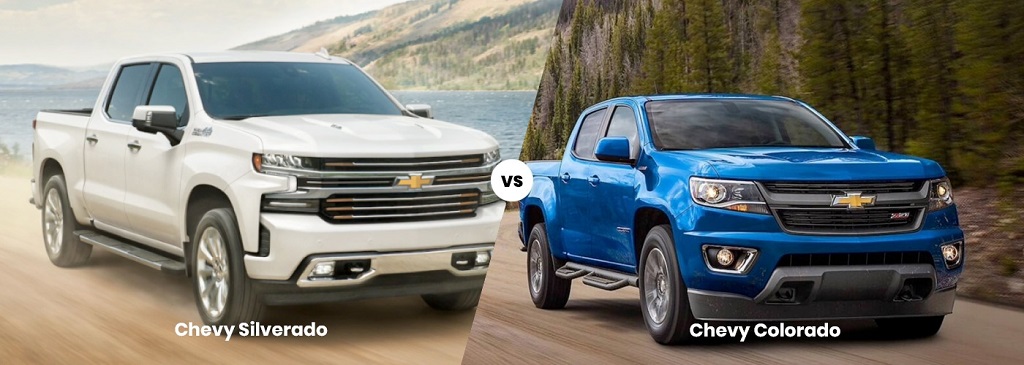
This is where the Silverado often pulls ahead — but the Colorado still surprises many.
- The Colorado can tow **up to 7,700 lbs** in optimal configurations.
- Payload capacity in the Colorado is more modest — typically in the **1,700–1,800 lb** range (varies by trim).
In comparison, the Silverado 1500 in certain trims can tow significantly more (somewhere in the realm of **9,500 lbs+**) and carry higher payloads, though exact numbers depend on which engine and package you pick.
If your work regularly requires towing heavy trailers, large equipment, or livestock, the Silverado offers a much wider margin. But for many moderate uses (campers, small trailers, boats), the Colorado is often sufficient and comes with less tradeoff in daily driving.
Interior & Technology
Inside, both trucks have improved over the years, but you’ll find the differences to be meaningful.
- The Colorado offers a functional and modern interior, with decent materials, infotainment, and technology, though some trims will use harder plastics in less prominent areas.
- The Silverado, because of its higher starting position, often provides more premium options — from leather upholstery, larger touchscreens, to more luxury-leaning amenities in upper trims.
- Space in the Silverado is usually more generous, especially in rear seats and legroom — an advantage for passengers or hauling people often.
Off-Road Capability
If you’re eyeing trails and backroads, both trucks have off-road variants.
- The Colorado lineup includes trims like **ZR2**, **Trail Boss**, and **Z71**, with suspension upgrades, skid plates, and better ground clearance.
- Silverado has off-road trims such as **Trail Boss** and **ZR2**, which bring lifted suspension, off-road tuned shocks, skid protection, and other enhancements.
In general, the Silverado’s off-road versions tend to offer more capability, but also more weight and complexity. The Colorado’s off-road trims are competitive in its class and often give better maneuverability on tighter trails.
Price & Value
The gap in cost between these trucks is substantial.
- The Colorado’s base trims often start in the low-to-mid range for midsize trucks (in the U.S. market). U.S. News estimates its starting MSRP around **$31,900** for base models.
- Silverado base models (1500, lower trims) start significantly higher, and trailing up in high-end trims becomes very expensive.
- Because the Silverado has more capability, more parts, and often more complexity, cost of ownership (maintenance, fuel, insurance) is higher — especially in premium or performance trims.
For many buyers, the Colorado offers most of the daily benefits at a more moderate cost. The Silverado pays off when your work or demands push it beyond what a midsize can comfortably handle.
Safety & Reliability
- Both trucks come equipped with modern safety and driver assistance features, like forward collision alerts, lane-keeping, and more in higher trims.
- The Colorado has earned respectable safety ratings — for instance, it gets a **4-star overall** from NHTSA in current configurations.
- Silverado’s heavier structure and broader adoption make safety crashworthiness and parts support very solid. Because it’s a more mature, larger model line, parts and service tend to be more accessible.
- Reliability ultimately depends on how the truck is used, maintained, and which variant you choose. Both brands (Chevy/Maker) have long track records in the pickup space.
Related Topic: Eco-Friendly Garage Door Repairs
Which Truck Should You Choose?
Here’s a quick decision guide based on your priorities:
- Daily driving, tighter spaces, moderate towing needs: Go with the **Colorado** — less bulk, lower cost, still capable.
- Frequent heavy towing, heavy loads, more passenger space: Pick the **Silverado** — especially in higher trims or HD variants.
- Off-road focus: Both trucks have strong off-road trims; if you want more capability, a Silverado ZR2 or Trail Boss is likely better, but Colorado ZR2 or Trail Boss is more trail-friendly in tighter terrain.
- Budget vs long-term cost: Colorado gives you a more manageable entry point while the Silverado demands more investment up front and in upkeep.
Related Topic: How to Use a Scullery Machine
Conclusion
In short, Colorado and Silverado serve different roles in Chevrolet’s lineup. The **Colorado** is for those who want the utility of a truck without the full-size burden. The **Silverado** is for those whose demands exceed what a midsize can reliably offer. Neither is universally “better” — the right choice depends on what *you* need.
If you like, I can also generate a version optimized for SEO or local markets (e.g. Bangladesh) or prepare a shorter version. Want me to do that next?.