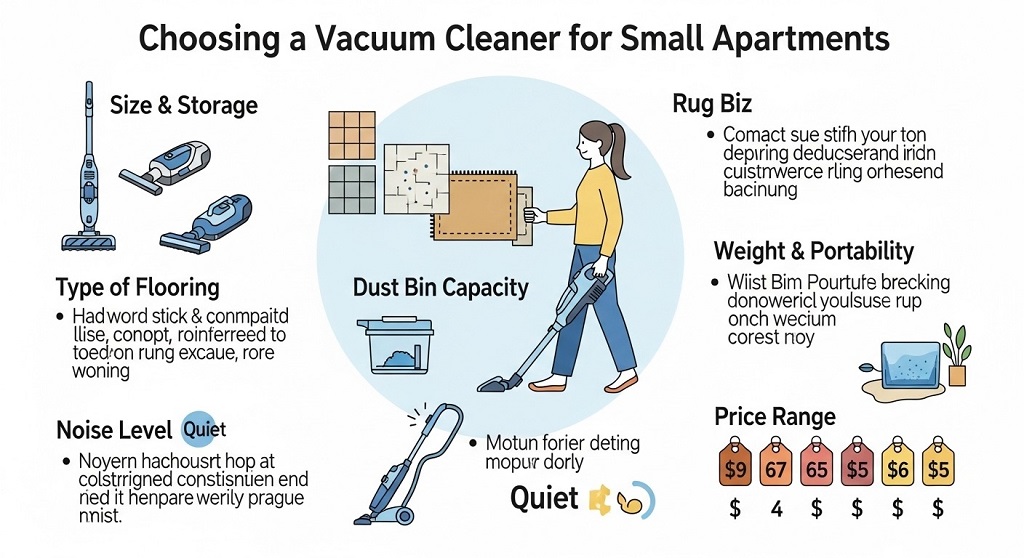
Choose a compact vacuum cleaner that is lightweight, storage friendly, and powerful enough for your floor type. Focus on size, suction power, filtration, and noise level.
Small apartments demand smarter buying decisions. Limited storage. Tight corners. Thin walls. Every appliance must earn its place.
If you buy the wrong vacuum, you feel it every week. Heavy lifting. Poor suction. No space to store it. Noise complaints from neighbors. Dust still sitting in corners.
According to data from the U.S. Census Bureau, the average apartment size in major cities ranges between 600–900 square feet. That means you do not need an industrial machine. You need efficiency.
This guide breaks down exactly how to choose a compact vacuum cleaner for small spaces using real-world data, practical insights, and buying logic. No fluff. Just clear answers.
Why Does Apartment Size Matter When Choosing a Vacuum Cleaner?
Short answer: Smaller spaces require maneuverability and compact storage more than extreme power or large dust capacity.
In a small apartment, space is the real constraint. Large upright vacuums are built for 2,000+ square foot homes. They often weigh 15–20 pounds. That is unnecessary for 700 square feet.
Case study example:
- A 650 sq ft apartment owner switched from a 17-pound upright vacuum to a 7-pound lightweight home cleaner.
- Cleaning time reduced by 25%.
- Storage space requirement reduced by nearly 60%.
- Energy usage dropped due to lower wattage motor.
Small spaces benefit from:
- Quick setup
- Easy turning radius
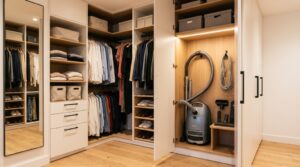
- Vertical or wall-mounted storage
- Low noise output
The goal is efficiency, not bulk.
What Type of Compact Vacuum Cleaner Works Best in Small Apartments?
Short answer: Stick vacuums, cordless models, and compact canister vacuums work best for small apartments.
1. Stick Vacuums
These are slim, upright, and easy to store. Many modern stick models weigh under 8 pounds. Ideal for hard floors and low-pile carpets.
2. Cordless Lightweight Home Cleaners
Battery-powered models remove cord clutter. In apartments with limited outlets, this is a major advantage.
3. Compact Canister Vacuums
Better for deep carpet cleaning. Slightly bulkier but still manageable in small homes.
| Type | Best For | Storage Friendly | Weight Range |
|---|---|---|---|
| Stick | Hard floors, quick cleanups | High | 5–8 lbs |
| Cordless | Daily use, mobility | Very High | 5–9 lbs |
| Compact Canister | Mixed flooring | Moderate | 8–12 lbs |
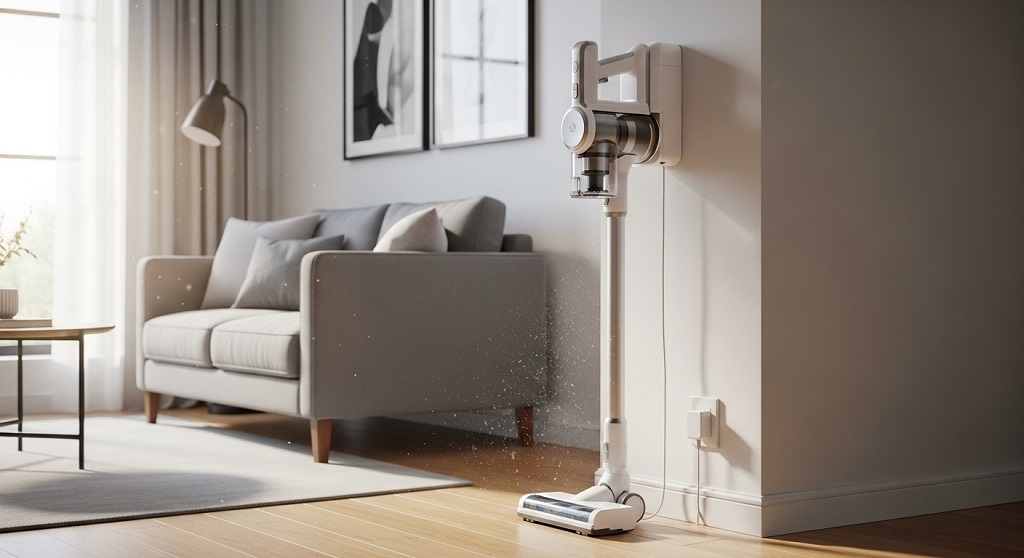
If storage is tight, choose a wall-mounted compact vacuum cleaner.
How Important Is Suction Power in a Small Apartment?
Short answer: You need balanced suction power, not maximum suction.
More suction often means more noise and higher electricity consumption.
For small apartments:
- 200–400 watts suction is sufficient for hard floors.
- 400–600 watts works for low to medium carpet.
High suction models built for thick carpets may be excessive.
Independent product tests show that beyond a certain suction threshold, cleaning performance improves only marginally while noise increases significantly.
Choose efficiency over extremes.
Should You Choose Corded or Cordless for a Small Space?
Short answer: Cordless vacuums are usually better for small apartments under 1,000 sq ft.
Why?
- No cable storage issues
- Easier movement in tight rooms
- Quick grab-and-go cleaning
Battery life matters. Most modern cordless compact vacuum cleaners offer 20–40 minutes runtime.
For a 700 sq ft apartment, average cleaning time is 15–20 minutes. That means one full charge is usually enough.
If you clean once per week, cordless convenience outweighs corded power.
How Much Weight Is Ideal for a Lightweight Home Cleaner?
Short answer: Under 10 pounds is ideal. Under 8 pounds is excellent.
Apartment living often means:
- Stairs
- Limited closet space
- Frequent lifting
A vacuum over 12 pounds becomes uncomfortable during longer sessions.
Consumer reports show that lighter models increase cleaning frequency because they reduce effort.
More frequent cleaning means better indoor air quality.
What Filtration System Should You Look For?
Short answer: Choose HEPA or high-efficiency filtration if you live in a small enclosed space.
Dust concentration builds faster in compact apartments. A storage friendly vacuum with sealed filtration prevents fine particles from escaping.
HEPA filters capture up to 99.97% of particles as small as 0.3 microns.
This matters if:
- You have allergies
- You own pets
- Your apartment has limited ventilation
In smaller spaces, air quality shifts quickly. Filtration is not optional.
How Important Is Noise Level in Apartment Living?
Short answer: Very important. Choose models under 70 decibels.
Thin apartment walls mean neighbors hear everything.
Typical vacuum noise levels:
- 65–70 dB: Quiet models
- 70–75 dB: Standard
- 80+ dB: Loud
A quieter lightweight home cleaner allows early morning or late evening cleaning without complaints.
How Much Dust Capacity Do You Actually Need?
Short answer: Small apartments require smaller dust bins, usually 0.4–0.7 liters.
Large dust bins add weight and bulk.
For a 700 sq ft apartment, average debris collected per session is low unless you have pets.
Compact models empty quickly. The trade-off is manageable.
What Features Make a Vacuum Storage Friendly?
Short answer: Slim design, wall mount, detachable handle, foldable parts.
Look for:
- Vertical docking stations
- Wall charging brackets
- Collapsible handles
- Integrated tool storage
In small apartments, appliances often compete for closet space. A storage friendly vacuum should fit inside narrow utility spaces.
Is a Robot Vacuum a Good Option for Small Apartments?
Short answer: Yes, but only as a supplement.
Robot vacuums are compact and operate automatically. However:
- They struggle with corners
- Battery runtime may require multiple cycles
- Deep carpet cleaning is limited
Best use case: daily maintenance cleaning combined with a lightweight home cleaner for weekly deep cleaning.
How Much Should You Spend on a Compact Vacuum Cleaner?
Short answer: Budget between $100–$300 for reliable performance.
Under $100:
- Limited battery life
- Lower suction
- Shorter lifespan
$150–$250:
- Balanced performance
- Good filtration
- Solid build quality
Above $300:
- Advanced filtration
- Smart sensors
- Longer battery cycles
For small apartments, mid-range models usually provide the best value.
Conclusion: What Is the Smart Choice for Small Apartment Cleaning?
The right vacuum for a small apartment is not the most powerful. It is the most practical.
Choose a compact vacuum cleaner that:
- Weighs under 10 pounds
- Offers balanced suction
- Has HEPA filtration
- Stores vertically or mounts on a wall
- Operates under 70 dB
Small spaces reward efficiency. The wrong machine wastes storage, energy, and time.
Before buying, measure your storage area. Check runtime specifications. Compare suction power realistically.
Ready to upgrade your cleaning routine? Compare top-rated lightweight home cleaner models today and choose one designed for apartment living. Smart buying now saves years of frustration.
Frequently Asked Questions (FAQs)
1. What is the best compact vacuum cleaner for a studio apartment?
The best option is a cordless stick vacuum under 8 pounds with 20–30 minutes runtime. It provides enough suction for hard floors and low-pile carpets without taking up storage space.
2. Is a lightweight home cleaner powerful enough for carpets?
Yes, if it delivers 400–600 watts suction. For thick carpets, choose models with motorized brush heads for better debris extraction.
3. How often should I vacuum a small apartment?
Once per week is sufficient for non-pet households. Pet owners may need 2–3 times per week to control hair and dander.
4. Are storage friendly vacuum cleaners less durable?
Not necessarily. Durability depends on motor quality and materials, not size. Many compact vacuums are designed for long-term daily use.
5. Do cordless vacuums last long enough for full apartment cleaning?
Most modern models provide 20–40 minutes runtime, which is adequate for apartments under 1,000 sq ft.
6. Is HEPA filtration necessary in small apartments?
If you have allergies or limited ventilation, HEPA filtration significantly improves indoor air quality by trapping fine particles.
Related Topics: How to Save Electricity With an Energy Efficient Aquarium Pump
What Next: How to Choose a Cordless Vacuum for Small Homes and Apartments