
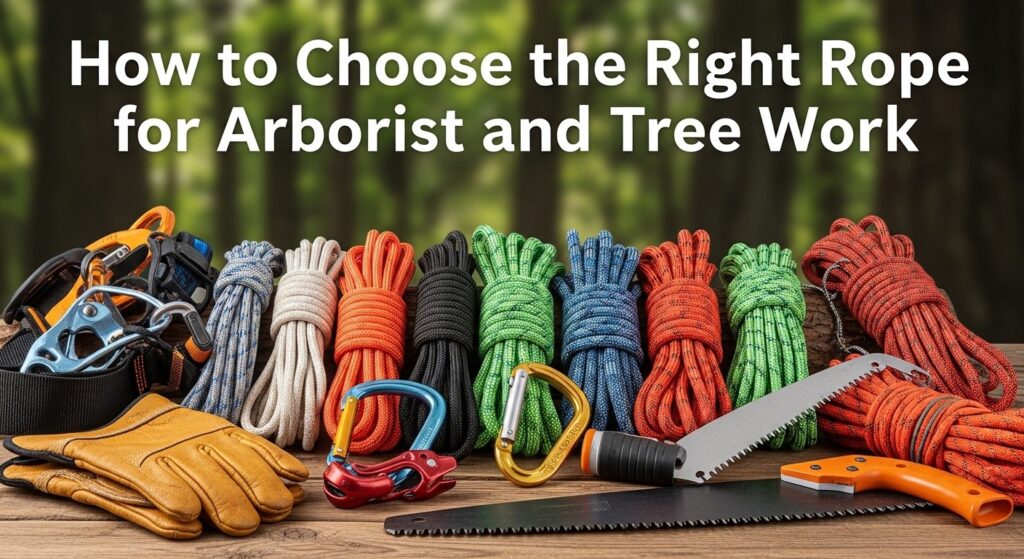
The right rope for arborist and tree work is a certified tree climbing rope designed for life support, typically 11–13 mm in diameter, with low stretch, high tensile strength, and compatibility with your climbing system. For most professional climbers, a low elongation rope made from polyester or nylon/polyester blends offers the best balance of strength, durability, and control.
If you choose the wrong rope, you risk poor control, excessive bounce, premature wear, or worse—system failure. According to industry safety reports from OSHA and TCIA, falls remain one of the leading causes of injury in tree care operations. Rope selection directly impacts fall protection, positioning stability, and overall job efficiency.
This guide breaks down exactly how to select the right rope based on climbing system, elongation level, diameter, material, and safety standards. You will also see real-world considerations drawn from industry case data and manufacturer testing benchmarks.
Why Does Rope Choice Matter So Much in Tree Work?
Because your rope is your primary life-support system.
In arboriculture, ropes are not just access tools. They are fall protection systems, positioning anchors, and load-bearing components. A poorly chosen rope can cause:
- Excessive bounce during ascent
- Reduced friction device performance
- Premature sheath wear
- Lower efficiency in SRT or DdRT systems
- Increased fatigue over long climbs
Case data from professional training organizations shows that rope elongation over 3% under working load can reduce positioning accuracy during canopy movement. In complex removals or precision pruning, that margin matters.
Professional arborists often report improved productivity when switching to purpose-built tree climbing rope models with optimized sheath construction and low elongation cores.

What Is a Tree Climbing Rope?
A tree climbing rope is a static or semi-static rope engineered specifically for arborist applications, designed for minimal stretch, high abrasion resistance, and compatibility with friction devices.
Unlike dynamic climbing ropes used in rock climbing, arborist ropes prioritize stability over energy absorption. Tree work requires controlled ascent, stable work positioning, and efficient descent—not dynamic fall catching from high-impact drops.
Most tree climbing rope models are:
- 11 mm to 13 mm diameter
- Double braid construction
- Polyester sheath for abrasion resistance
- Low elongation under load (1–3%)
- Certified under ANSI Z133 and CE EN standards
Modern ropes are engineered for compatibility with mechanical ascenders, friction hitches, and descent devices.
What Is a Low Elongation Rope and Why Does It Matter?
A low elongation rope stretches minimally under load—typically less than 5% at working load—providing stability and efficient energy transfer during climbing.
In tree work, too much stretch creates bounce. Bounce reduces efficiency and increases fatigue. It also affects precision during limb walking or chainsaw operation.
Low elongation rope offers:
- Better control in SRT systems
- Less energy loss during ascent
- Improved device consistency
- Reduced climber fatigue
Testing by rope manufacturers shows that ropes with 2% elongation at 10% MBS (Minimum Breaking Strength) provide noticeably better ascent efficiency compared to ropes exceeding 4% stretch.
If you’re evaluating options, review certified specifications carefully. For example, some professionals explore options like this detailed breakdown of rope construction and performance:
low elongation rope comparison insights.
How Do You Choose the Correct Rope Diameter?
Choose rope diameter based on device compatibility, hand feel, and workload. Most arborists use 11.5 mm–12.5 mm ropes.
| Diameter | Best For | Considerations |
|---|---|---|
| 11 mm | SRT systems, mechanical devices | Lighter, faster handling, may wear faster |
| 11.5–12 mm | General professional climbing | Balanced performance |
| 12.5–13 mm | Heavy removals, friction hitches | Durable, stronger hand grip |
Mechanical devices like ZigZag or Rope Runner often specify compatible diameter ranges. Always confirm device manufacturer recommendations.
Which Rope Construction Is Best for Arborists?
Double braid construction is the industry standard for tree climbing rope.
Double braid ropes have:
- An inner load-bearing core
- A protective outer sheath
- Balanced strength distribution
This design improves abrasion resistance and maintains round shape under load.
Three-strand ropes are sometimes used for rigging but are rarely ideal for modern climbing systems.
What Material Should You Choose: Polyester or Nylon?
Polyester is preferred for low stretch and UV resistance; nylon offers higher elasticity but more elongation.
- Polyester: Low stretch, strong UV resistance, stable under wet conditions
- Nylon: Higher elongation, absorbs more energy, more stretch
For arborist climbing lines, polyester or polyester blends dominate due to consistent performance and reduced bounce.
How Strong Should a Tree Climbing Rope Be?
Look for a minimum breaking strength (MBS) of at least 5,000–7,000 lbs (22–31 kN) for life-support applications.
ANSI Z133 guidelines require arborist climbing lines to meet strict safety benchmarks. Most professional-grade ropes exceed 24 kN MBS.
However, strength alone is not enough. You must consider:
- Working load limit (WLL)
- Safety factor (typically 10:1 for life support)
- Compatibility with knots and splices
Field case reviews show that improper rope inspection—not tensile weakness—is a leading cause of rope-related incidents.
Should You Choose SRT or DdRT Compatible Rope?
Choose based on your climbing system.
For SRT (Single Rope Technique)
- Lower elongation preferred
- Smaller diameter (11–11.5 mm)
- High sheath durability
For DdRT (Moving Rope System)
- 12–13 mm common
- Good friction hitch performance
- Slightly thicker sheath for wear resistance
Industry training data shows SRT adoption has increased in commercial arboriculture due to energy efficiency and reduced ascent fatigue.
How Long Should Your Arborist Rope Be?
Standard lengths range from 35 m (115 ft) to 60 m (200 ft).
Choose rope length based on:
- Average tree height in your region
- Whether you use canopy anchors
- Base tie vs canopy tie setups
Many professionals carry multiple rope lengths to adapt to different site conditions.
How Do You Inspect and Maintain a Tree Climbing Rope?
Inspect before and after every climb.
- Check sheath for glazing or cuts
- Feel for core inconsistencies
- Inspect splices
- Wash with mild soap when dirty
- Store dry and away from UV exposure
Data from rope manufacturers indicates that proper cleaning can extend rope lifespan by up to 20% in high-dust environments.
What Certifications Should You Look For?
Look for ANSI Z133 compliance, CE EN 1891 Type A certification, and manufacturer traceability.
These standards confirm:
- Minimum strength thresholds
- Elongation limits
- Impact resistance benchmarks
Never use uncertified rope for life-support applications.
What Mistakes Should You Avoid When Choosing a Rope?
Avoid choosing based on price alone.
- Do not use dynamic climbing rope for arborist work
- Do not exceed device diameter limits
- Do not ignore elongation specs
- Do not skip compatibility checks
Cost savings on rope rarely offset the risk of failure or reduced productivity.
Conclusion: How Do You Make the Right Final Decision?
The right rope is not the most expensive one. It is the one that matches your climbing system, meets certified safety standards, and provides low elongation for stable positioning.
Start with diameter compatibility. Confirm MBS ratings. Check elongation data. Verify certifications. Then evaluate sheath durability based on your work type.
Tree work is demanding. Your rope must perform consistently under load, weather exposure, and repeated friction cycles.
If you are reviewing rope specifications and comparing options, study detailed breakdowns and verified performance metrics before buying.
Choose smart. Climb safe. Work efficiently.
Frequently Asked Questions (FAQ)
1. What is the best diameter for a tree climbing rope?
Most professionals prefer 11.5 mm to 12 mm for balance between strength, durability, and device compatibility.
2. Is low elongation rope better for arborists?
Yes. Low elongation rope reduces bounce, improves positioning, and increases climbing efficiency.
3. Can I use rock climbing rope for tree work?
No. Rock climbing ropes are dynamic and designed for fall absorption. Arborist ropes are semi-static for stability.
4. How often should I replace my climbing rope?
It depends on usage. Heavy daily use may require replacement within 12–24 months. Always retire rope after significant damage.
5. What is the minimum breaking strength I should look for?
Look for at least 22 kN (around 5,000 lbs), though most professional ropes exceed this rating.
6. Does rope color matter?
Color does not affect strength but can improve visibility in canopy work and job site organization.
Related Topic: How to Choose a Cordless Vacuum for Small Homes and Apartments
Read Next: How to Use Sound Therapy Singing Bowls During a Meditation Spa Day